
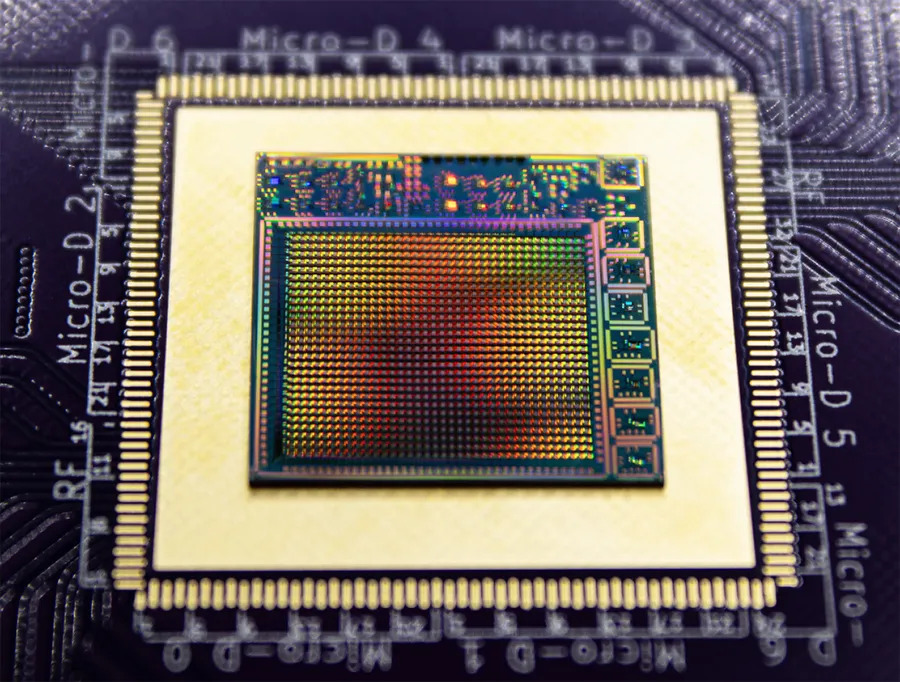
Artificial intelligence has crept into nearly every industry, and the companies building its hardware keep hunting for harder domains to flex in. The latest area runs particularly hot: the plasma inside a fusion reactor.
On Monday Brookhaven National Laboratory debuted a superconducting chip designed to help monitor fusion plasma in real time. The lab developed it with other U.S. Department of Energy facilities and the AI hardware start-up Great Sky.
Before fusion powers anything, its machines must be able to control misbehaving plasma. The chip’s makers hope their hardware can operate quickly enough to keep pace with changes in the plasma and help control them.
Such chips are destined for tokamaks, the large, doughnut-shaped machines that use magnets to hold the fusion plasma in place and that sit at the heart of many proposed fusion power plants. The extremely hot plasma fuel inside is temperamental. When it acts unexpectedly, it can cause a disruption, a sudden collapse that sheds its energy and can harm the device. “Disruptions are something that are kind of existential for tokamaks,” says Michael Churchill, a research scientist at the Princeton Plasma Physics Laboratory, who worked on the project. “If we can’t figure out how to control disruptions, then we won’t have an operating tokamak.”
Trouble can come on fast, but analyzing the plasma live takes lots of data, and processing these can easily bog down typical computers. Neuromorphic AI systems, which mimic the structure of the human brain to crunch huge amounts of data in parallel, could keep up. Great Sky builds its version out of superconducting circuits—a cousin of the hardware used inside some quantum computers—which is meant to let the company run its specialized AI right on the chip at the speed the job demands.
The chip hasn’t been wired to a working tokamak yet. Instead the team replayed data recorded at the DIII-D tokamak in San Diego, Calif., at its original clip of a million samples per second, and the chip kept up while running algorithms meant to flag anomalies and predict disruptions. The AI model on the chip is much smaller than, say, today’s large language models, and the team is still writing up its results for publication. “All of this is very demonstration-stage right now,” Churchill admits.
It’s unclear whether this will make nuclear fusion more reliable and safe or remain a show of chip power. Tokamaks already run without chips like this one, and their control mechanisms can’t react to problems with the plasma as fast as the new chip is meant to detect them. “I’m personally more excited about the use of AI in the area of materials discovery,” says Carlos Paz-Soldan, an associate professor of applied physics at Columbia University.
Shinjae Yoo, who chairs Brookhaven’s AI department and led the project, isn’t pinning the chip’s future on fusion alone, either. He wants to test it out in places where a traditional data center won’t fit. “I see immediate benefit in edge computing because it’s operating at the gigahertz” speed, Yoo says. “It has a memory already integrated.”
First, though, the team intends to build a successor chip with a neural network that will be 10 times larger. and it plans to debut that chip at Brookhaven early next year and install at DIII-D sometime after. It’s then that Great Sky’s hardware could finally face a fusion plasma with no hard drive in between.
Publication : Scientific American
Author : Peter Hall
"We built AmplePoints to give campaigns and agencies a better way to connect with voters—one that's engaging, rewarding, measurable, and compliant," said Tony Singh, CEO and Founder of AmplePoints. "Our Agency Partner Platform helps campaigns maximize every outreach dollar while giving customers a reason to participate."